
FANUC CRX-3iA and P-55/15-21A at FABTECH 2026: What Maintenance Teams Should Stock
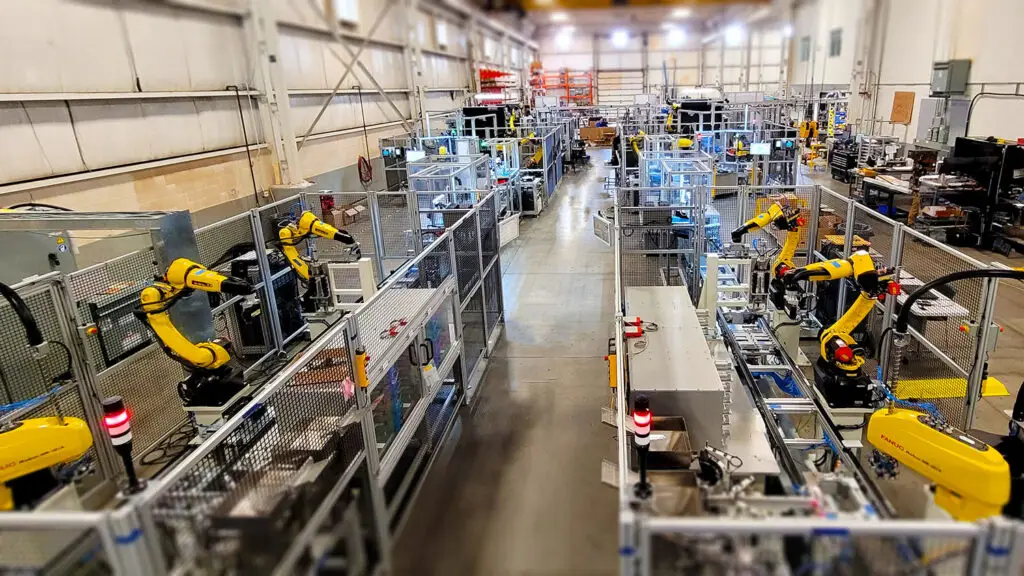
In short: FANUC America put two new machines on the FABTECH 2026 floor — the 11 kg CRX-3iA collaborative robot and the P-55/15-21A paint robot — in the company’s main booth (S40006) and paint booth (S11008) at the Las Vegas Convention Center on 21–23 October 2026. Neither was a world premiere: FANUC America had already opened CRX-3iA orders on 20 April 2026, and a pre-series P-55/15-21A had already run in Europe in April. For a maintenance or spares desk the useful part of the announcement is narrower than the marketing frame: a confirmed specification set, one repeatability figure that still differs between FANUC’s own regional material, and a controller change (the new R-50iA option) that will move part numbers away from the R-30iA-era cells many plants are running today.
FABTECH is a fabrication show — forming, welding, cutting and finishing — so the FANUC stand was built around process demos rather than a product catalogue. That matters when you read the coverage: several of the applications attributed to “FANUC’s new cobot” were cell-level demonstrations using other models. The paragraphs below separate what each machine is specified to do from what the booth as a whole did.
Quick facts: what was shown and what is confirmed
| Item | What it is | Figures FANUC publishes | Status at FABTECH 2026 |
|---|---|---|---|
| CRX-3iA | Lightest model in the CRX collaborative robot line, aimed at portable and high-mix tasks | Robot weight 11 kg (24 lb); payload 3 kg; reach 692 mm; magnetic base; automatic mounting-angle detection | United States trade-show debut; on order in North America since 20 April 2026 |
| P-55/15-21A | Midsize paint robot for coating larger parts | Payload 15 kg (33 lb); reach 2,100 mm (83 in); hollow wrist; single control cabinet; battery-free encoders | United States debut of a model shown as a pre-series unit in Europe in April 2026 |
| CRX-10iA/L Paint | Explosion-proof collaborative paint robot | Payload 10 kg; reach 1,418 mm; ATEX-certified; Scan-to-Path and No Code programming | Described by FANUC as the world’s first explosion-proof collaborative paint robot |
| R-50iA controller | New controller option for the CRX line | Higher-frequency ROS 2 and streaming motion support; auxiliary-axis positioner support for coordinated welding and laser work | Announced with the CRX-3iA in April 2026, not at the show |
| CRX-30iA palletising upgrade | Software and accessory change, not a new arm | Palletising up to 40 kg when paired with a new high-flow air kit for large suction grippers | Announced April 2026 |
Why “debut” at FABTECH is not the same as “new”
The word FANUC used in its 5 October 2026 release was “FABTECH debut” for both machines, and the company’s own event page for the show repeats that framing. The release history is longer. The CRX-3iA first appeared publicly at iREX in Tokyo in December 2025, with production planned from January 2026, and FANUC America announced it for North America on 20 April 2026, stating that the machine “is now available for customer order”. FANUC’s European launch material followed through the trade press in June 2026, with a United Kingdom showing scheduled for that region’s open days in November. The P-55/15-21A appeared as a pre-series unit at Paint Expo in Karlsruhe on 14–17 April 2026, where FANUC said the European market launch was expected during 2026.
That timeline is the practical part. Anyone quoting a CRX-3iA into a budget in October 2026 is buying a machine that has been orderable for roughly six months, which means early-adopter installations already exist and the first failure demand has already started to accumulate — usually on the process tooling rather than the arm.
CRX-3iA: the specification, and the one number that conflicts
The machine is defined by weight rather than by payload. At 11 kg the arm can be carried to a job by one person, which is the design premise: FANUC positions it for welding, part handling, small assembly, screwdriving, tool positioning and inspection in tight spaces or temporary areas where a permanent fixture cannot be justified. The published figures are a 3 kg payload and 692 mm of reach.
- Mounting. Optional magnetic base, plus wall or ceiling mounting, with automatic detection of the mounting angle so the operator does not re-enter orientation data. Vertical orientation is the point: FANUC’s target applications are shipbuilding and large structural fabrication, where the weld is vertical-up and the workpiece cannot be turned.
- Deployment tolerance. FANUC supports touch sensing, so the robot does not need to be repositioned to a precise datum after being moved, and offers automatic weld-point detection with automatic path generation. Its “Servo Robot Smart Ring” and wrist-mounted controls are intended to let a path be planned from a scan rather than from point-by-point teaching.
- Process. A new “Triangle Weave” welding profile is aimed at out-of-position work; FANUC describes it as counteracting weld-puddle sag, which is what makes vertical-up bead placement achievable on a cobot.
Where the numbers diverge is repeatability. Material circulated with FANUC’s European launch quotes ±0.02 mm repeat accuracy for the CRX-3iA; the North American launch release carries no repeatability figure at all, listing weight, payload and reach only. That is not necessarily a contradiction — regional sheets are written for different standards and one number may be measured with a different tool-centre-point definition or load condition — but it is a reason to insist on the data sheet for the exact model and firmware you are quoting, particularly if the cell has a tolerance-driven process behind it.
“The CRX-3iA puts collaborative automation in the hands of operators — literally,” said Eric Potter, general manager of robot application engineering at FANUC America, at the April launch. “Its lightweight design makes it easy to redeploy in minutes, helping manufacturers automate jobs that were once too small, too scattered or too costly to justify.”
The rest of the April announcement is the bigger spares story
Three changes to the CRX family, announced with the CRX-3iA rather than at FABTECH, will shape what a spares cupboard looks like over the next few years.
- A new controller generation. The CRX line becomes available on FANUC’s R-50iA controller, which brings higher-frequency ROS 2 and streaming-motion support for AI-driven applications, plus auxiliary-axis positioner support for coordinated welding and laser cells. Every controller change eventually splits a parts list: cabinet fans and filters, power supplies, fuses and I/O boards are catalogued per controller family, and cross-referencing between generations by assumption is how wrong parts get ordered.
- Higher payloads through accessories, not new arms. CRX-30iA palletising now supports up to 40 kg when paired with a new high-flow air kit for large suction grippers, and a new high-inertia mode lets a CRX guide very heavy loads while a lift-assist device carries the weight. Both shift wear into the gripper and air-supply side, which is consumable territory.
- Fastening duty. CRX cobots can now drive dual nut runners, with an optional internal wiring harness. Internal harnesses reduce external cable damage — and move the repair from a field-replaceable cable dressing to a factory-level operation.
FANUC also repeats an eight-year maintenance-free claim across the CRX family and a payload span of 3–40 kg. Treat the maintenance claim as covering the robot’s own mechanics under FANUC’s stated duty conditions. It does not cover the torch, the applicator, the gripper, the positioner, the controller’s wear items, or the collision that ends a cell’s week.
P-55/15-21A: the maintenance changes are the point
The P-55/15-21A is a midsize paint robot — 15 kg payload, 2,100 mm reach — and the details FANUC chose to publish are mostly about upkeep rather than speed.
- Single control cabinet. FANUC says the explosion-proof circuits were redesigned with fewer components so that all functions fit in one cabinet. Fewer explosion-proof enclosures and interlocks in the paint loop means fewer gaskets, purging components and cable entries to maintain.
- Battery-free encoders. On battery-backed absolute encoders, the battery pack is a scheduled consumable; a battery-free design removes it from the plan for this model. It does not remove it from the older paint robots already installed alongside it, so expect the task to stay on the schedule even after this machine arrives.
- Hollow wrist. Air, paint and signal lines route through the arm, which protects them from snagging but concentrates wear inside the wrist where bell, hose and fitting changes happen.
- Demo. On the FABTECH paint booth the machine used integrated line tracking with a VersaBell 3 applicator to coat moving football helmets — a demonstration of tracking accuracy and repeat coating thickness rather than of a new consumable.
The companion on that stand was the CRX-10iA/L Paint, FANUC’s ATEX-certified collaborative paint robot at 10 kg and 1,418 mm, which the company calls the world’s first explosion-proof collaborative paint robot. Collaborative coating without a full paint booth enclosure is a different safety case per plant, so treat the certification as the start of the conversation with your integrator, not the end of it.
What the booth demonstrated, and what it did not
Several FABTECH demonstrations were credited to the new machines but were not. The coordinated-motion welding cell used a CRX-10iA/L on an integrated seventh-axis rail with a positioner turning a mower deck through 180 degrees for seam-tracking welds. A two-cobot cell paired a CRX-30iA with a CRX-10iA for assembly, welding and post-process weld inspection. Heavy structural work was shown with an M-950/500F-28A — 500 kg payload, 2,830 mm reach — alongside two ARC Mate robots simulating excavator bucket welding. Plasma cutting ran on a dedicated Hypertherm interface with Shape Generation 3 software, and a LR-10iA/10 cell performed precision corner welding of stainless steel before laser marking. Bolt tightening at 30 kg on a dozer track used force control on a CRX-30iA, and an AI-guided kitting demo combined Google Cloud and Gemini Enterprise with iRVision machine vision on a CRX-20iA and an LR Mate.
Read that list as the parts taxonomy of a FANUC cell: rails and positioners, external axes, force-control software options, vision hardware, plasma and laser interfaces. Those are where replacement demand appears, and most of them are not new SKUs.
The spares clock for a new robot model
Autronexa’s assessment, not a FANUC statement: new robot models reach the aftermarket in three stages. Machine builders specify them first; the installed base grows; failure demand from two- to five-year-old machines follows. Inside that window, expect distributor lead times rather than local stock for model-specific parts, and expect regional part numbering for a China-, Japan- or US-localised SKU to be confirmed in writing before a quote is cross-referenced.
| Category | What moves first | Why it matters now |
|---|---|---|
| Process consumables | Contact tips, nozzles, diffusers, liners, gas diffusers, bell cups and needles, filters | Tied to the torch or applicator, not the robot model, so they are available on day one and are the highest-frequency line items |
| Sensing and tooling | Weld tracking sensors, scan hardware, gripper pads, suction cups, tool cables | The CRX-3iA’s pitch is redeployment, which multiplies the number of tools and dressings per arm |
| Controller wear items | Cabinet filters and fans, fuses, power supplies, teach pendant cables | Split by controller generation once the R-50iA option spreads; do not assume R-30iA-era substitutions |
| External axes | Rail drives, positioner belts and couplings, encoder feedback on auxiliary axes | Added by the coordinated-motion applications FANUC is demonstrating, and rarely on the initial spares list |
| Software and options | Weld profiles such as Triangle Weave, high-inertia mode, force control, ROS 2 interface licences | Not physical spares, but a machine that loses a licence or a controller image is down just as long |
| Crash replacement | Arm assemblies, reduction units, harness sets | First demand on a new model comes from collisions on the earliest production machines, not from scheduled wear |
Practical checklist before a CRX or P-55 reaches your plant
- Ask for the data sheet for the exact model and controller combination — CRX-3iA on R-30iA-era hardware and CRX-3iA on R-50iA are not the same spares list.
- Do not carry a ±0.02 mm figure into a tolerance-driven process case without confirming which regional document it came from and how it was measured.
- Back up the controller image, robot parameters and software option list on commissioning day, while the integrator is still on site; a collaborative arm that is easy to move is also easy to collide.
- Stock the process consumables for the torch, applicator and gripper you specify, not for the robot. That is where the reorder frequency lives.
- For a magnetic-base deployment, add the mounting surface and cable dressing to the inspection list — there is no bolted base plate to absorb misalignment, and the harness takes the abuse.
- Get regional availability and part numbering for the P-55/15-21A in writing. A model whose European launch was still “expected in 2026” in March does not automatically have a local distribution channel in your country at the same time.
- Keep one known-good teach pendant, one known-good encoder battery compartment reference from your existing FANUC cells and one known-good spare fuse kit on the shelf so a new-model arrival can be compared against a working baseline.
FANUC parts Autronexa lists today
Our current FANUC catalogue is CNC-side rather than robot-side, which is still where many plants start their search because the same maintenance desk buys for both. We list A02B-0303-D500, a 10.4-inch colour LCD display unit without touch panel for the Series 30i/31i/32i controls, A02B-0072-C101, a 9-inch monochrome CRT/MDI operator interface for the Series 10T, A02B-0047-B001, a power supply unit for an early FANUC control rack, and A02B-0120-K301, a 20-pin ribbon connector kit for Series 16/18 controls. None of those is a CRX or P-55 spare, and we say so deliberately rather than implying a fitment. Browse the wider pool under FANUC parts, communication modules, PLCs and controllers, I/O and function modules and cables and connectors, or search the full product catalogue. If a robot cell or the CNC beside it is down, send the nameplate data with the part number — the model suffix is where these catalogue items usually go wrong.
Related reading on this site: managing industrial automation obsolescence with surplus stock, which covers the last-time-buy decision that a new controller generation eventually forces, and our news and guides index.
Frequently asked questions
Was the CRX-3iA launched at FABTECH 2026?
No. FANUC America announced the CRX-3iA and said it was available for customer order on 20 April 2026. FABTECH 2026, held 21–23 October at the Las Vegas Convention Center, was its debut at that show, described in FANUC’s own release as a “FABTECH debut”.
What are the confirmed CRX-3iA specifications?
FANUC publishes an 11 kg (24 lb) robot weight, a 3 kg payload and 692 mm reach, with optional magnetic base mounting, wall or ceiling mounting, automatic mounting-angle detection, touch sensing, automatic weld-point detection and automatic path generation. A ±0.02 mm repeat-accuracy figure appears in European launch material but not in the North American release, so verify it against the data sheet for your model.
What is the P-55/15-21A and what changed for maintenance?
It is a midsize paint robot with a 15 kg payload and 2,100 mm reach. FANUC’s published changes are a hollow wrist for protected media routing, redesigned explosion-proof circuits with fewer components so all functions fit in a single control cabinet, and battery-free encoders. At FABTECH it ran line tracking with a VersaBell 3 applicator.
Can I buy spares for these robots yet?
Process consumables for the torch, applicator and gripper are available now because they are not new part numbers. Model-specific parts for a machine this new typically take 12–24 months to build a local aftermarket, so plan on distributor lead times. With the CRX line moving onto the R-50iA controller, confirm part numbers against the controller generation rather than substituting from an older cell.
Does “eight years maintenance free” mean no spare parts are needed?
No. That claim covers the robot’s own mechanical maintenance under FANUC’s stated duty conditions. It does not cover welding torches and applicators, suction cups and grippers, controller filters, fans and fuses, teach pendants, external cabling, positioners and rails, or damage from a collision — which is where most unplanned demand on a robot cell comes from.
Sources
- FANUC America press release: demonstrations for welding and painting at FABTECH 2026 (PR Newswire, 5 October 2026)
- FANUC America press release: CRX-3iA and new CRX lineup capabilities (PR Newswire, 20 April 2026)
- FANUC America event page: FABTECH 2026, 21–23 October, Las Vegas Convention Center, booths S40006 and S11008
- FANUC Europe: Paint Expo 2026 preview with P-55/15-21A and CRX-10iA/L Paint detail (13 March 2026)
- The Fabricator: FABTECH 2026 returns to Las Vegas, 21–23 October (17 September 2026)
- New Equipment Digest: FANUC at FABTECH 2026, with imperial payload and reach conversions (5 October 2026)
- Trade report of FANUC’s European CRX-3iA launch, including the ±0.02 mm repeat-accuracy figure (4 June 2026)
- Trade coverage of the CRX-3iA reveal at iREX and FANUC’s January 2026 production plan (15 December 2025)
Assessment and disclaimer: the spares-timing analysis, the failure-demand table and the checklist above are Autronexa’s interpretation of publicly available manufacturer material, not statements by FANUC. Specifications quoted are those published by FANUC America and FANUC Europe at the dates cited; regional data sheets differ and figures can change with firmware. Confirm every part number, tolerance and lead time against current manufacturer documentation and a written quotation before ordering.
Need a hard-to-find spare? Send us the manufacturer, model and nameplate details and we will confirm condition, availability and lead time — request a quote.