
Rockwell CompactLogix 5390: 43% Smaller, 128 Axes, Built-In Security
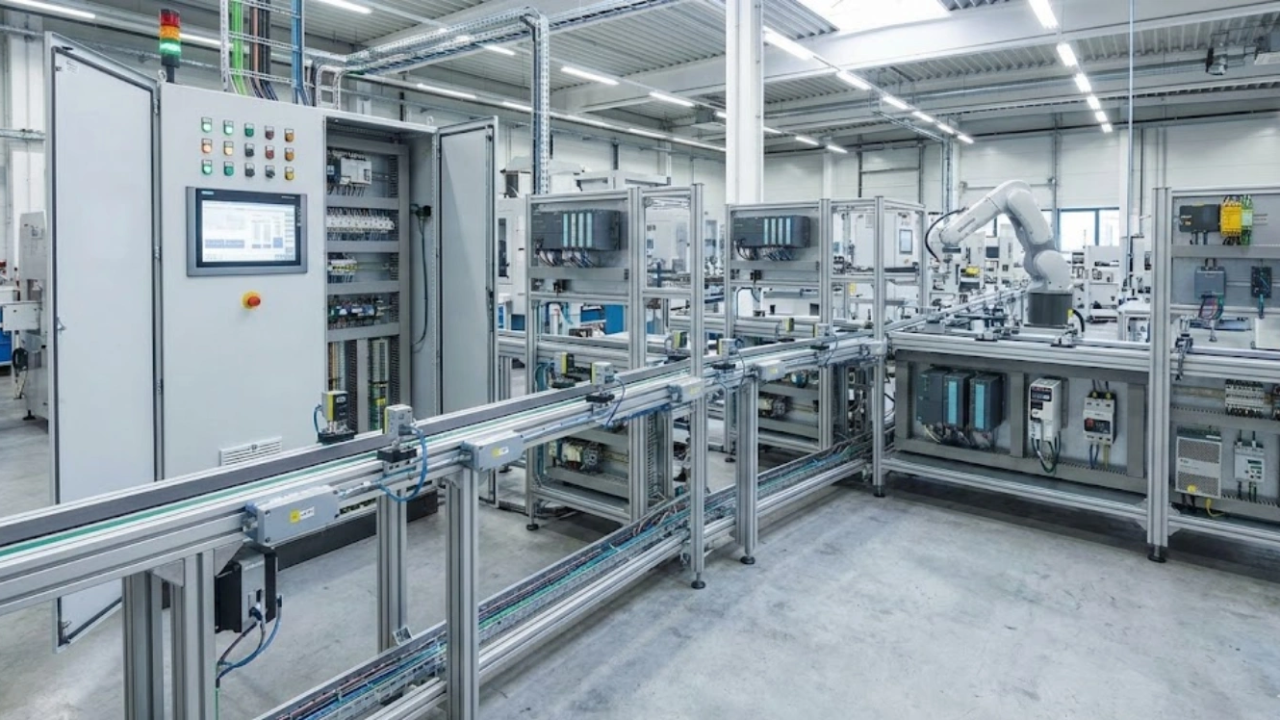
In short: Rockwell Automation announced the CompactLogix 5390 controller on 13 October 2026. Rockwell says it is 43% smaller than the CompactLogix 5380 it sits above, and that it lifts the compact platform to 128 motion axes, 4,000 OPC UA nodes and up to 32 PointMax I/O modules, with functional safety and IEC 62443-4-2-aligned cybersecurity in the same controller. For a plant or a spares desk running 5069-generation machines, the useful question is narrower than the marketing frame: the 5380 is not being withdrawn, so what actually changes is design momentum, not the installed base.
The 5380 remains an active product in Rockwell’s catalogue, and the 5390 launch did not come with an end-of-life notice for the 5069 line. New machine programmes will standardise on the 5390 over the next few years. Existing machines will keep running 5380 controllers for the rest of their service life — which is where most spare-parts demand still comes from.
What Rockwell actually announced
The 5390 is the compact member of the Logix refresh that began with the ControlLogix 5590 in October 2025. Rockwell positions it for OEMs, system integrators and end users building complex machines, process skids and production systems — the segment where a controller has to handle motion, safety, high-density I/O and data services at once without a rack full of extra hardware.
The company’s stated pitch is that compliance and performance no longer trade against each other. Senior product manager Siva Iyyamperumal framed the launch around exactly that: manufacturers are being asked to deliver more performance while absorbing tighter safety and cybersecurity requirements, and Rockwell’s answer is to put all of it on one platform rather than adding modules and gateways around it.
| Item | What Rockwell states | Where it comes from |
|---|---|---|
| Announcement date | 13 October 2026, via PR Newswire (Rockwell Automation, NYSE: ROK) | Press release |
| Positioning | New generation of the Integrated Architecture controller family; compact, high-performance tier | Press release |
| Footprint | 43% smaller than the CompactLogix 5380 | Press release |
| Motion | Up to 128 integrated motion axes on EtherNet/IP | Product page |
| Information capacity | 4,000 OPC UA nodes | Product page |
| Local I/O | Up to 32 PointMax I/O modules (Bulletin 5034) | Product page |
| Network | Dual-IP, device-level ring (DLR), star and linear topologies | Product page |
| Built-in security technologies | CIP Security and Syslog | Product page |
| Cyber standard | IEC 62443-4-2 alignment; described as ready for EU Cyber Resilience Act requirements | Both, with caveats below |
| Software | Studio 5000 Logix Designer and FactoryTalk Design Studio | Product page |
| Certifications listed | UL Listed Component, CCC, KC, RCM, UKCA | Product page |
| Catalog numbers, memory sizes, safety ratings, price, lead time | Not disclosed in the launch material reviewed | Open question |
Rockwell also notes sustainability points: recycled content in the product, lower power consumption and a reduced carbon footprint relative to the previous generation. Those claims are not quantified in the release.
How the 5390 compares with the 5380
The headline number is the footprint, but the specification jump that matters most for machine design is motion. The 5380 tops out at 32 integrated axes and 31 local Compact 5000 I/O modules. The 5390 quadruples the axis count and swaps the local I/O family to PointMax.
| Parameter | CompactLogix 5380 (5069) | CompactLogix 5390 |
|---|---|---|
| Integrated motion axes | Up to 32 | Up to 128 |
| Local I/O | Up to 31 Compact 5000 modules | Up to 32 PointMax modules |
| OPC UA capacity | Not a published headline figure | 4,000 nodes |
| User memory | 0.6 MB to 10 MB standard; 0.3 MB to 5 MB safety on the GuardLogix variants | Described as scalable; sizes not published at launch |
| Network ports | 1 Gb embedded EtherNet/IP, dual configurable ports with dual IP | Dual IP with DLR, star and linear topologies |
| Controller-level security | Change detection, logging, encrypted firmware, role-based access to routines and add-on instructions | Adds CIP Security and Syslog as built-in technologies |
| Functional safety | Separate Compact GuardLogix 5380 models: SIL 2 / PL d in 1oo1, SIL 3 / PL e in 1oo2 | Integrated into the platform; SIL/PL ratings not published at launch |
| Engineering software | Studio 5000 Logix Designer | Studio 5000 Logix Designer and FactoryTalk Design Studio |
| Footprint | Baseline | 43% smaller, per Rockwell |
The axis count is the line that changes machine architecture. A 128-axis ceiling moves the 5390 into territory that previously pushed builders toward ControlLogix or a multi-controller compact design. That is why this launch matters beyond the “smaller box” story: it lets a builder consolidate several compact controllers into one, which changes the spare-parts profile of the machine as much as the panel layout.
Does 43% smaller mean a 43% smaller cabinet?
No, and it is worth being precise about this before a layout is signed off. Rockwell states a 43% reduction in the controller’s footprint relative to the 5380. It does not say in the launch material whether that figure refers to panel area, enclosure volume or overall dimensions, and a controller is only one item in a cabinet that also holds drives, contactors, terminals, power distribution and wiring duct.
The realistic saving is smaller but still meaningful: a shorter DIN rail run, less depth for the I/O stack, and — because PointMax carries higher channel density per module — fewer modules for the same point count. On a machine series built in volume, that compounds into a standardised cabinet that fits more easily into a shipping envelope and a customer’s floor plan. Treat 43% as the vendor’s headline claim and confirm it against the 5390 dimensional drawing for the specific model once catalog numbers are published.
What PointMax I/O changes for panel builders
PointMax (Bulletin 5034) is not new — Rockwell introduced it in 2025 and opened ordering in the third quarter of that year. What is new is that it can now be used as local I/O on a compact controller, not only as remote I/O.
Rockwell’s PointMax documentation lists three design consequences that matter at the panel level:
- Single-slot safety modules — safety and standard I/O share the same slice width, so the safety points no longer dictate a deeper, wider assembly.
- No MOD power budget calculation — the engineering step of summing module power against the backplane supply is removed from the I/O configuration.
- Field power over the backplane — no separate field power distribution (FPD) module, which removes a component and its wiring from the bill of materials.
For a maintenance team, the practical consequence is a different module family to learn. A plant that has stocked Compact 5000 (5069) I/O for years will find the 5390 expects PointMax slices, and the two are not interchangeable. That belongs in the transition plan, not in a commissioning-week surprise.
Is the 5390 certified to IEC 62443-4-2?
Rockwell’s wording deserves careful reading, because “aligned”, “compliant” and “certified” are three different things and the launch material moves between them.
The press release describes cybersecurity capabilities that meet IEC 62443-4-2 and says the controller is prepared to support EU Cyber Resilience Act requirements. The product page goes further and lists “compliance to IEC 62443-4-2” and the CRA. Neither source names an assessment body, a certificate number or a target Security Level (SL 1 to SL 4). IEC 62443-4-2 is a requirements standard for industrial automation components; a capability statement is not the same as a certified component.
That distinction matters commercially. The Cyber Resilience Act places obligations on the manufacturer placing a product with digital elements on the EU market — for a machine, that is usually the machine builder, not the controller vendor. A controller that supports the technical requirements makes the builder’s conformity work easier; it does not transfer the obligation or complete the CE marking.
| Date | What applies under the EU Cyber Resilience Act |
|---|---|
| 10 December 2024 | Regulation (EU) 2024/2847 entered into force |
| 11 September 2026 | Article 14 reporting obligations apply: actively exploited vulnerabilities and severe security incidents must be reported through ENISA’s Single Reporting Platform, with a 24-hour early warning and a 72-hour notification |
| 11 December 2027 | Full application: all essential cybersecurity requirements, technical documentation, vulnerability handling and CE marking |
Against that timetable, the 5390’s built-in CIP Security and Syslog are useful, concrete features rather than badges. CIP Security secures EtherNet/IP traffic between devices; Syslog forwards controller events to a collector, which is what an incident-response process actually needs. Those are the parts an integrator can point at during an audit.
What happens to the 5380 and its spare parts
Nothing immediate. Rockwell continues to list the 5069-L3xx controller models as active, and the 5390 announcement is an addition to the family, not a replacement order. Historically, a Logix generation stays in production for years after its successor arrives, and then moves through a published lifecycle status per catalog number before any last-order date.
What shifts is where new design effort goes. Expect three things over the next 24 months:
- OEM standardisation moves to the 5390. New machine series will be designed around PointMax and the higher axis count, and their spare-parts lists will be built from the start on the new family.
- The 5380 installed base becomes the dominant spares market. Every machine shipped before the transition keeps its 5069 controllers, and those are the units that will need replacement parts first.
- Software, not hardware, is the earlier constraint. The practical cut-off for an older controller is usually the last Studio 5000 version that supports it, not the last date it can be bought. Archive the project file and the firmware revision with the machine record.
If your plant is still on SLC 500 or MicroLogix, the pressure is older and separate. Rockwell has already discontinued a number of SLC 500 catalog numbers and directs users to the 5370 or 5380 platforms. Those machines are the ones most exposed to a single-point failure, because the aftermarket supply of 1746 and 1762 parts is finite and shrinking.
Which parts should a maintenance team stock during the transition?
The list below is ordered by how often the item stops a line, not by how new it is. Where Autronexa lists a matching part, the link goes to the product page; where the platform is broader than one part number, the link goes to the series guide.
If you are new to the range, the Allen-Bradley spare parts buying guide explains how the families are structured and how ordering works, and the Allen-Bradley brand page shows what we currently hold.
| Family | What it covers | Why it belongs on the list | Start here |
|---|---|---|---|
| 5069 CompactLogix 5380 | The controller itself, with its integrated power supply | A controller or firmware failure stops the machine outright, and there is no separate power supply to swap as a cheap first test | PLCs and controllers |
| Compact 5000 I/O | Local and remote I/O for 5069 systems | Channel damage from field wiring and short circuits is the most common unplanned swap | I/O and function modules |
| 1734 POINT I/O | Distributed I/O on EtherNet/IP, including configurable modules | Still widespread on machines built before Compact 5000; adapters and slices fail independently of the controller | 1734-8CFG · series guide |
| 1794 Flex I/O | Older distributed I/O blocks | Legacy platform with thinning supply; a failed block can idle a whole cell | 1794-OB8 |
| 1756 ControlLogix | Chassis, power supplies and I/O for larger cells | Where process and high-axis applications sit; power supplies and output modules are the usual wear items | 1756-PAR2 · 1756-OA8D · series guide |
| 2711P PanelView Plus | Operator terminals | Backlight and touch-layer wear are predictable failures on ageing HMIs | 2711P-T7C1D6 |
| PowerFlex 22x and Kinetix 2097 | AC drives and servo drives on Logix machines | Capacitor and fan ageing inside drives is a scheduled replacement, not an accident | 22D-D017N104 · 2097-V34PR6 · 22 series guide |
Two older families are worth naming separately, because they sit at the edge of any Rockwell transition plan: the 1746-NIO4V analog combination module for SLC 500, and the 1762-L40BWA MicroLogix 1200 controller. Both are still in service in large numbers and both are on borrowed time. If a line depends on either, the decision is migrate or hold stock — not wait.
Smart motor controllers follow the same logic. The 150-F1250NBED and 150-F780JBE SMC Flex units are solid-state assemblies with limited repair options in the field, which makes a tested spare the practical strategy.
How to confirm a replacement before you buy
Rockwell’s compact part numbers carry more information than most catalogues make obvious, and the differences that matter are often one suffix character. Work through this in order:
- Record the full catalog number, including the series letter. A 5069 controller’s suffix encodes motion, safety, process or conformal-coat options, and they are not interchangeable.
- Capture the firmware revision and the Studio 5000 version from the running project. This is the constraint that most often blocks a like-for-like swap.
- Note the I/O family on the machine, not just the controller. Compact 5000 (5069) and PointMax (5034) slices do not mix on the same controller architecture.
- Check lifecycle status per catalog number, not per family. Rockwell publishes active and discontinued status at the part-number level.
- Ask for the condition in writing — new, new surplus, or repaired — and the warranty that goes with it.
We wrote a longer version of this process in the Allen-Bradley replacement confirmation guide, and a part-number checking routine in how to verify an automation part number. If you are weighing surplus against new for a legacy line, managing obsolescence with surplus stock sets out the trade-offs.
What is still unknown about the 5390
Five things were not in the material reviewed, and each one affects a purchasing or engineering decision:
- Catalog numbers and memory options — no 5390 part numbers are listed yet, so no quote is possible on a specific model.
- Safety ratings — Rockwell describes integrated safety but does not publish SIL or PL levels for the 5390.
- Whether a GuardLogix 5390 follows — the 5380 generation split standard and safety into separate model families; the 5390 launch does not say whether that split continues.
- Program migration path — no conversion guide has been published. Both generations run the Logix engine and Studio 5000, so the usual catalogue-change-and-verify route is the expectation, but confirm before committing a machine programme.
- Price, availability and lead time — none announced.
Until those are settled, the sensible posture is to design new machines around the 5390 only where the axis count or cabinet space justifies the change, and to keep 5380 spares coverage unchanged.
Bottom line
The CompactLogix 5390 is a real generational step for the compact tier: 128 axes and 4,000 OPC UA nodes in a package 43% smaller than the 5380 changes what a single controller can carry. The cybersecurity story is directionally right but still a capability claim rather than a published certification. For the installed base, the launch changes almost nothing this quarter — which is exactly why the next 18 months are the window to map your 5069 machines, archive their firmware and project files, and decide which parts you hold rather than chase.
Is the CompactLogix 5390 a replacement for the 5380?
It is the next generation in the same compact tier, not an immediate replacement. Rockwell continues to list the 5069 CompactLogix 5380 models as active. New designs will move to the 5390 because of the higher axis count and smaller footprint; existing machines can stay on the 5380 for the rest of their service life.
Is the 5380 discontinued?
No. No end-of-life notice accompanied the 5390 launch, and the 5069-L3xx models remain active in Rockwell’s catalogue. Discontinuation in the Logix family is announced per catalog number, with a published lifecycle status and a last-order date.
What does “43% smaller” actually measure?
Rockwell states a 43% reduction in the controller’s footprint versus the 5380 but does not specify in the launch material whether that is panel area, enclosure volume or overall dimensions. For cabinet layout, confirm the figure against the 5390 dimensional drawing for the exact model once catalog numbers are published.
Is the 5390 certified to IEC 62443-4-2?
Rockwell states that its cybersecurity capabilities meet IEC 62443-4-2 and that it is prepared to support EU Cyber Resilience Act requirements, and the product page lists compliance with both. No assessment body, certificate number or target Security Level is named in the material reviewed. Treat it as an alignment claim until a certificate is published.
Does the 5390 use Compact 5000 or PointMax I/O?
PointMax. Rockwell specifies up to 32 PointMax (Bulletin 5034) modules as local I/O on the 5390. The 5380 uses up to 31 Compact 5000 (5069) modules. The two I/O families are not interchangeable, which affects both the bill of materials and the spares you hold.
What should I stock while the transition happens?
Keep covering the 5380 you already run: the controller itself, its Compact 5000 I/O, the network adapters and any PanelView terminals on the machine. Add a PointMax slice or two only if you have committed to a 5390 design. The expensive mistake is stocking the new family before a machine exists and leaving the old one uncovered.
Sources
- Rockwell Automation press release: CompactLogix 5390 controller extends the Integrated Architecture family (PR Newswire, 13 October 2026)
- Rockwell Automation: CompactLogix 5390 controllers — product page with axes, OPC UA and PointMax figures
- Rockwell Automation: CompactLogix 5380 controllers — baseline specifications and active catalog numbers
- Rockwell Automation: PointMax I/O (Bulletin 5034) product overview and ordering window
- Rockwell Automation technical documentation: PointMax I/O modules, single-slot safety and backplane field power
- Rockwell Automation: SLC 500 discontinued catalog numbers and migration guidance to CompactLogix
- JD Supra: CRA Article 14 reporting obligations apply from 11 September 2026, ENISA Single Reporting Platform live
- Rockwell Automation: Automation Fair 2026 announcement, where the 5390 and PointMax are on the show floor
Assessment and disclaimer: the spares-planning analysis, the stocking table and the checklist above are Autronexa’s interpretation of publicly available manufacturer material, not statements by Rockwell Automation. Specifications quoted are those Rockwell published at the dates cited, and the launch material does not yet include catalog numbers, memory options, safety ratings, pricing or availability. Confirm every part number, rating and lead time against current manufacturer documentation and a written quotation before ordering.
Need a hard-to-find Allen-Bradley spare? Send the full catalog number, series letter and the machine it sits on, and we will confirm condition, availability and lead time — request a quote.